
THE OPERATING PROBLEM
A global marketing team was still producing pages one at a time
Motif’s customer-acquisition experience served 32 countries, but the publishing model did not scale with it. New pages typically began by duplicating an earlier page and editing it for the next campaign instead of being assembled from modular, reusable sections. Any new layout or behavior then moved through design, content, an external development partner, and repeated responsive QA.
The constraint was not a shortage of campaign ideas. The system made every page expensive to change—even when much of the structure already existed.
Duplicate, customize, hand off
- Duplicate a previous page
- Rewrite content and reshape the layout
- Send custom changes to external development
- Review the implementation across devices
- Repeat QA and fixes before launch
Assemble, localize, publish
- Select reusable page sections
- Enter campaign and localized content
- Preview shared responsive patterns
- Publish from a validated foundation
THE INTERVENTION
I moved the work from page production to system configuration
I led the brand and marketing experience redesign, then helped define the content model and reusable UI patterns for a decoupled Contentful and static-site architecture. The important shift was not the resulting component library, but streamlining the effort required from each team for each project launch.
Modular content architecture
Reusable sections carried known responsive behavior instead of requiring teams to duplicate complete pages.
Shared publishing workflow
Content editors could assemble and localize campaigns without initiating another bespoke engineering project.
Reusable design and code
Shared patterns kept behavior consistent while preserving enough flexibility for campaign and market needs.
THE CUSTOMER EXPERIENCE
Modularity supported a clearer brand experience—not a generic one
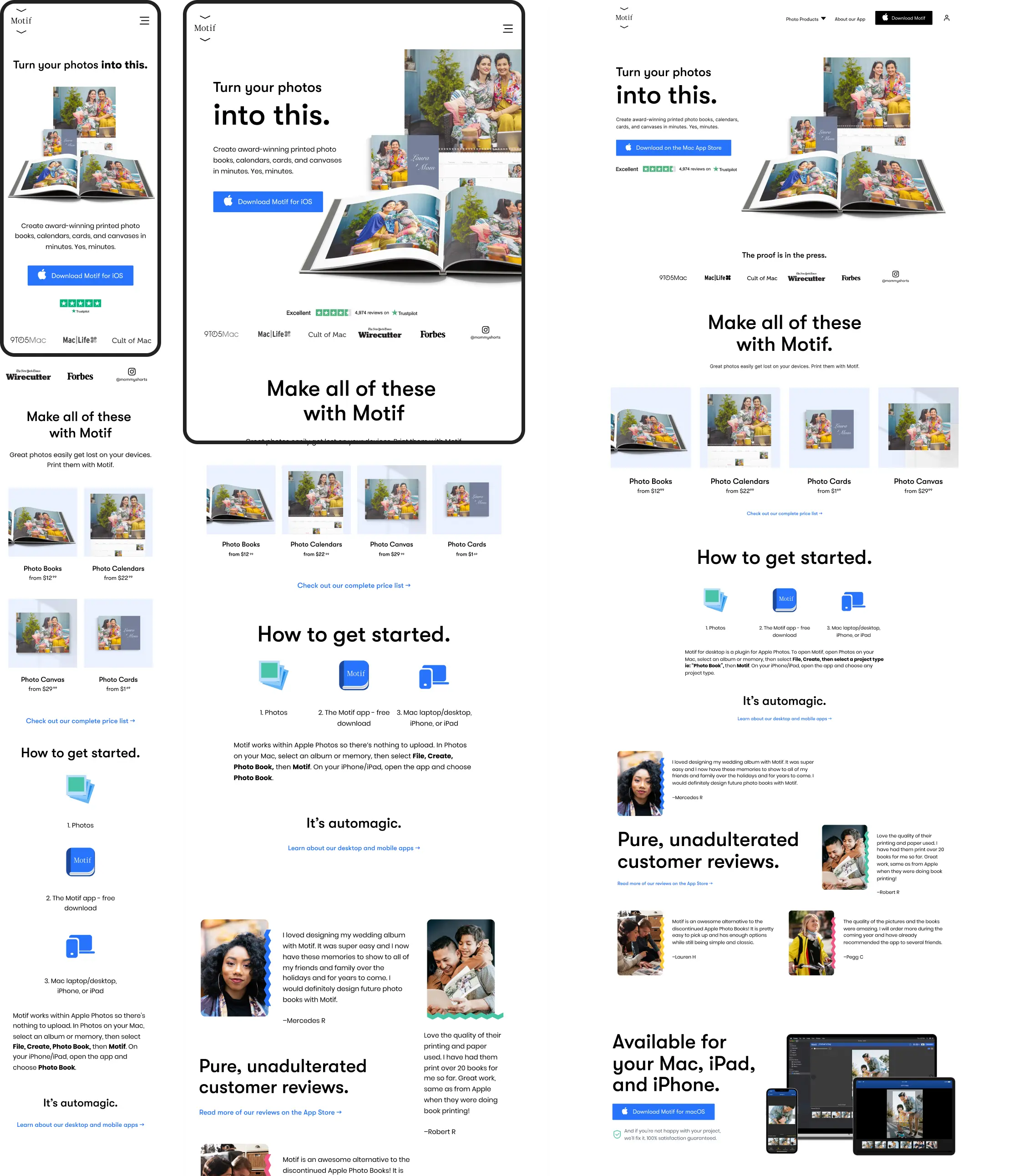
The responsive homepage used shared structures to make product value, pricing, trust signals, product range, and next steps easier to scan across breakpoints. The system created consistency underneath the experience while still leaving room for campaign storytelling and visual expression.
THE RESULT
Production stopped scaling linearly with every campaign
A page that had taken 5.5 weeks through external development could be produced in roughly three hours in the new workflow—a 98.7% reduction. Across the recurring work of design, content, engineering, QA, and vendor coordination, that recovered an estimated $200K in annual cross-team capacity.
The broader redesign also increased organic downloads by 55% among 25–34-year-olds, showing that the operational gains did not require sacrificing acquisition performance or customer-facing quality.
Takeaway: The highest-leverage design decision was not another campaign concept. It was changing the production model behind every campaign.